

The 2026 season of the Netball Super League kicked off on 27th February, marking another step forward for one of the fastest-growing competitions in UK sport. As the league continues to expand its audience following a major 2025 rebrand, the physical and psychological demands placed on players are higher than ever. Elite athletes must prepare carefully to meet the specific requirements of their position, from endurance and agility to strength and decision-making under pressure. Understanding these demands is essential for coaches, performance staff and sport scientists working in elite netball environments. The physical workload of players varies significantly depending on position, with different roles requiring specific combinations of endurance, speed, strength and technical skill. Positional roles in the Netball Super League require markedly different physical and tactical profiles. Comparing Loughborough Lightning’s Hannah Joseph and Berri Neil provides a useful illustration of how training approaches must be tailored to these role-specific demands.
Key physical demands of the Netball Super League
Players competing in the Netball Super League are exposed to a wide range of physical and cognitive demands during match play. These demands can broadly be grouped into several key performance areas:
Movement and distance
Speed and agility
Heart rate and intensity
Strength and power output
Cognitive and decision-making
These areas are all equally important for players to train and develop. Statistics show that the total distance travelled per match averages around 5-7 km per player, while players perform approximately 300-600 high-intensity movements per hour, depending on their position on the court.
These demands highlight the importance of conditioning programmes that replicate match intensity through repeated high-intensity drills.
Players also face similar demands in several other areas. These include fitness requirements, where endurance must be maintained across the full 60 minutes of match play, cognitive demands such as in-game decision making, and technical skills including dodging and interceptions. Alongside this, strong game understanding and knowledge of the rules remain essential components of performance.
How demands differ by position
Case study: Hannah Joseph VS Berri Neil
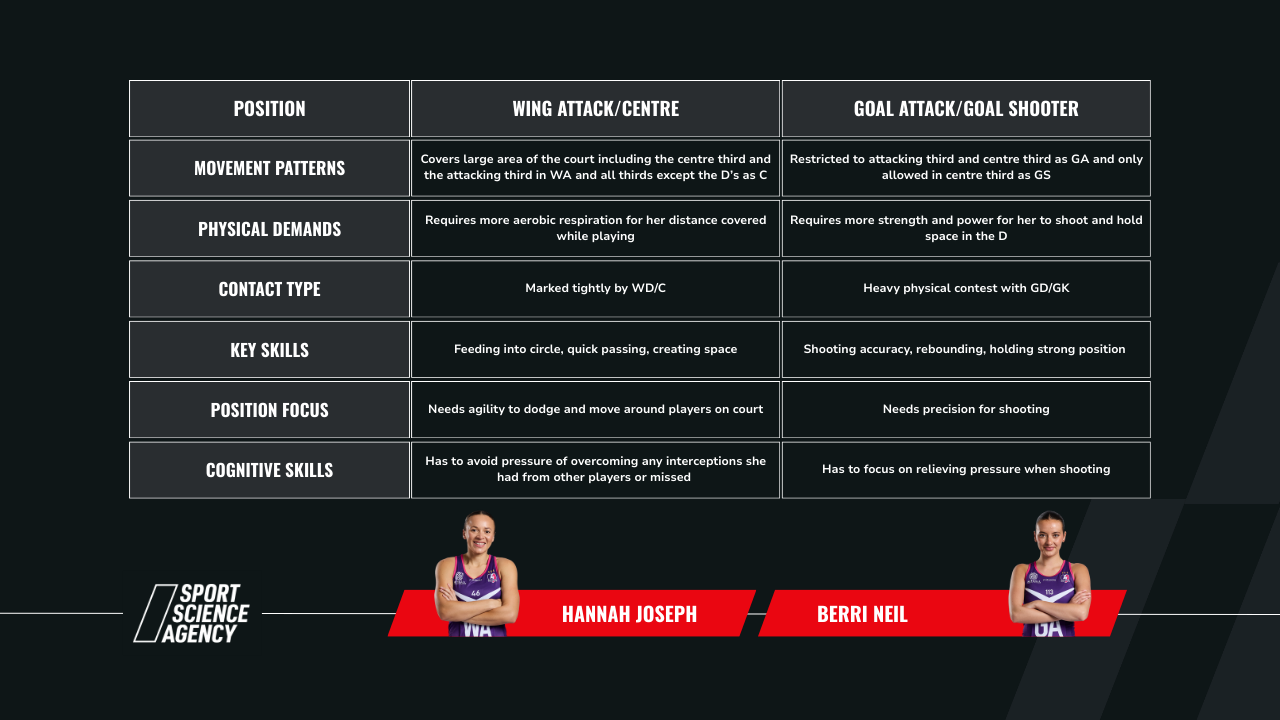
Players have a constant pressure to meet these demands, and require carefully crafted performance strategies to face them. These demands can vary for every single position on court, for example, Hannah Joseph and Berri Neil both play for Loughborough Lightning, but have opposite demands on court.
Hannah Joseph plays WA and C and Berri Neil plays GA and GS.
Why these demands matter
Hannah is more of a “whole court” player as she travels greater distances during a match. As a result, she relies more on aerobic energy systems to maintain endurance across the full 60-minutes. In contrast, Berri’s role inside the shooting circle requires greater strength and explosive power, particularly when contesting rebounds or holding position against defenders.
Hannah requires strong agility in order to move both herself and the ball up the court. This often involves dodging defenders and changing direction quickly to create space and progress play towards goal. If her agility was poor, situations such as a held ball (when the ball is held for longer than three seconds) or an interception could occur, resulting in a negative turnover and potentially giving the opposition a scoring opportunity. For this reason, agility is a key positional demand within her role.
For Berri, a key positional demand is shooting precision. Accurate shooting is essential not only for scoring points but also for maintaining team momentum and confidence. For example, missing several shots in a row means the team must repeatedly work the ball back up the court, which can increase physical fatigue. Repeated missed opportunities may also affect team belief and individual confidence. As a result, maintaining high levels of shooting accuracy is vital for both her own performance and the overall effectiveness of the team.
How players train to meet them
Players must be physically and mentally prepared to meet these demands. Strength and conditioning programmes are central to preparing athletes for the physical requirements of elite netball. Lower-body strength exercises, including squats and lunges, help develop the power required for jumping and rebounding. Plyometric training is also widely used, as it replicates the explosive movements required during match play. These exercises improve jump height, speed of movement, and landing control.
This is particularly important given the high rate of knee injuries in netball. Plyometric training also teaches players how to land safely from jumps, helping to reduce the risk of injury.
Recovery and rehabilitation also play a major role in helping players meet these demands. This includes both physical and cognitive recovery. For example, maintaining good sleep habits, typically around 7-9 hours per night, allows muscles time to repair and grow, while also giving the mind an opportunity to recover from physical and mental stress.
A structured cool-down is another important part of the recovery process. After an hour of high-intensity match play, players must allow the body to gradually return to a resting state. This is often achieved through light cycling, swimming, or mobility exercises. These activities help promote blood flow and reduce muscle soreness.
Recovery strategies are also essential for managing player workload across a competitive season, helping to reduce injury risk and maintain performance levels. These principles apply to all positions in netball and should be incorporated into training plans to ensure players can meet the physical and psychological demands of the Netball Super League.
EVERY SPORT HAS A PERFORMANCE STORY WORTH TELLING
In the Netball Super League, players must meet a wide range of physical and psychological demands. These requirements vary significantly by position, as shown through the contrasting roles of Hannah Joseph and Berri Neil at Loughborough Lightning. Meeting these demands relies on well-designed strength and conditioning programmes, including targeted strength training, plyometric work, and effective recovery strategies. For coaches and performance staff, understanding the specific demands of each position is essential when designing training programmes that support performance across the Netball Super League.
For leagues, governing bodies, and commercial partners, the ability to translate athlete performance insight into engaging content is becoming an increasingly valuable asset.
At Sport Science Agency, we work with rights holders, brands, and performance technology companies to turn sport science and performance data into credible, audience-focused storytelling.